
The Moment the Crowd Dances at 121 BPM
There is one moment where a DJ finds out who he really is, and it is never the moment when everything works.
SHALYO once took over a set from a DJ who had been playing techno, and who left the sync button on. “I come on to blow the place up, and I can’t work out why the crowd is dancing at 121 BPM when the track is 142.” What happened next is this man’s whole story in miniature: no panic, no rush.
“You have to wait for the right moment. I waited for the right moment, I got to it, I turned it up.”
A quiet passage came, the BPM climbed by degrees, and the floor exploded. “For me that’s a screw-up. The crowd didn’t even notice.”
Wait for the right moment. Remember that line. It will come back.

A Yamaha Organ, a Conservatory, Metal Bands
Shalev Gerbi started at nine: “My mother bought me a Yamaha organ.” Five hundred sounds, drum channels, hours of playing around. Then came piano lessons at the conservatory, then guitar, and gigs as a teenager in rock and metal bands. The musician was there first. Trance arrived later, through the back door.
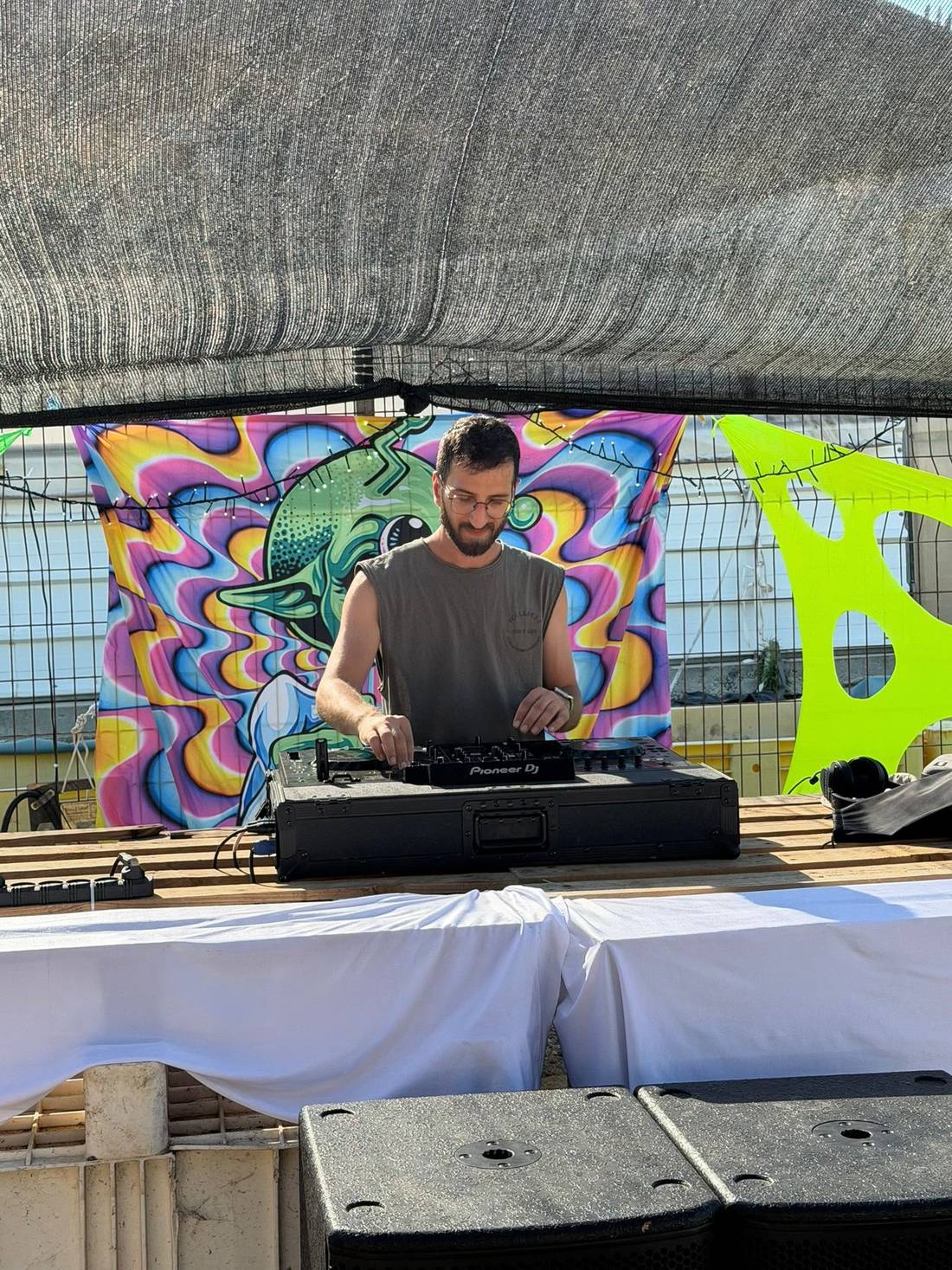
“You have to wait for the right moment. I waited for the right moment, I got to it, I turned it up.”
The Sisters’ Discs
“I got to know trance from my older sisters. They would go to parties and bring discs home.”
An Aiwa system with a three-disc changer, and hours upon hours of Astral Projection, Bubble, Zirkin, Bliss and Infected Mushroom.
And then, around sixteen, the realisation: “I noticed that no other music manages to move me the way trance does.” He describes it as “automatic dancing”, “a roller coaster”, almost a meditative state. But years would pass between that realisation and the making of anything.
“No other music manages to move me the way trance does.”
One Day, and the Next
The moment everything afterwards grew out of happened in India, after the army, across two consecutive days.
On the first day: a spontaneous guitar jam with a guy he had met there. The next day: the same party, the same guy.
“And I see him go up and play his own original music, and I saw everyone dancing to his original music, that he made himself.”
That is it. That is all it took. “I said: I have the musical knowledge. I’ll come back from India and I’ll start working on this hard, let’s go.”
And he came back, opened his computer, and downloaded software. FL Studio at first, Ableton Live today. Trial and error, years of trial and error. “Today I’m in a place I really, really love. I love sitting in the studio. I feel like I’m painting.”
“I love sitting in the studio. I feel like I’m painting.”
How “SHALYO” Was Born
A cafe belonging to a big chain, one he still refuses to name.
He says “Shalev”. The cashier writes it down with a letter too many, and what comes over the speaker is: “Shalyo!” His army friends never let it go, and the name stuck. Today friends from home and people at work both call him that. One slip in a name, one stage identity.

“Music Is Energy”
A year ago he sent a Facebook message to an artist he admired, only to compliment an album that had stayed with him: Aquatic Serenade, by Yaniv Ben-Ari, U-Recken. The message got a reply, the compliment turned into lessons, the lessons turned into mentorship: sound, shaping an artistic identity, rights. “In short, there really is nobody like him.”
On August 7th they share a stage, and SHALYO knows exactly what he wants to happen there: “To thank him so much, to shake his hand, to give him a hug.” And for Yaniv to hear the set, and say what he thinks.
And one sentence stayed with him, the sentence that changed the way he thinks about music: “Music is energy. A track is energy. It depends how you channel it.” With SHALYO that is not a slogan; he breaks it straight down into work: moving up one step on the Camelot wheel lifts the energy, moving up two launches it, tension that builds and releases into a peak.
“I brought a track across beautifully and precisely, and I watched the crowd explode. Exactly what I imagined would happen, happened.”
“Exactly what I imagined would happen, happened.”
Two Lives
“I get up with the little one in the morning and go to work, which is programming. I’m a developer at a tech company.” Just like that, no drama. Code by day. Studio at night, “until the small hours of the morning”. And in between: family.
And his daughter, a year and two months old, is “in love with daddy’s music”. She recognises the intros to his tracks and starts dancing. She got trance from the very first moment (“we got her used to it even from the womb”), and on the drive home from the hospital Infected Mushroom was already playing in the car. To this day she falls asleep to them on the road.
“I get so moved, and I start dancing with her. It’s a happiness there are no words to explain.”
The first time he played his own music on a real system was on his birthday, in front of his friends, with his family on the floor. “And it was a sublime feeling.”
Black Hole, and the Drawer That Opens at the Right Moment
Nine years of making music. Much of it for the drawer. Now the drawer opens.
Out of one jam came Black Hole: “I tried to make a track that gives the feeling of being pulled into the unknown... there are samples in there that talk about black holes, and it’s unpredictable, exactly like a black hole.” A whole EP grew out of it afterwards.
And where will the EP be played for the first time? In his words:
“It is on your stage, exactly, that I’m playing this EP for the first time.”
On August 21st it goes up on streaming; anyone on the floor on August 7th hears it first.
When we asked which emotion he wants to put into the music, he was not satisfied with one: “I plan to put in a whole range of emotions, from joy and laughter to excitement and power. And maybe it will even get a little dark.”
Five years from now he wants to be able to say that he has played Boom and Ozora, big festivals and small underground parties, and that an album has come out. But first: August 7th. Sunset, a dance floor, and the right moment.
He has waited long enough for it.